Thanks to Our Partners
This installation is generously supported by The Boshell Foundation / Betsey and David Todd.
Published Winter/Spring 2025
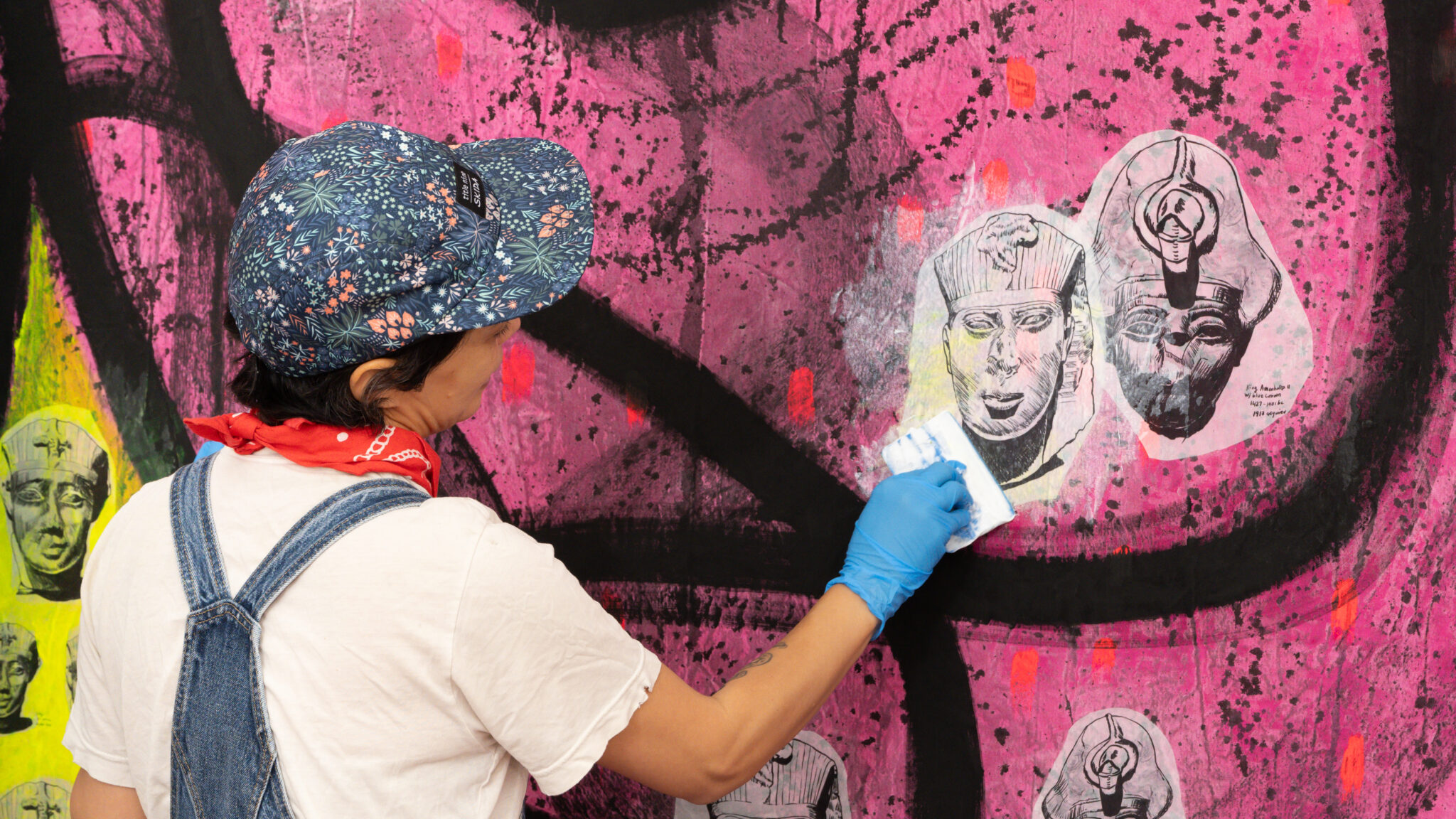
Artist Jackie Milad works on a large-scale collage in her Baltimore studio.
Jackie Milad’s light-filled studio in Baltimore’s Woodberry neighborhood is a cacophony of color. Her current work-in-progress covers much of its south-facing wall. Standing atop sturdy orange scaffolding with a long-handled brush in hand, she applies another layer of paint to a small swath of the fuchsia canvas on which she’s already made many marks. A graphic swirl of black snakes across the composition. A pop of thick and textured neon yellow leaps from the bottom left quadrant. Subtle black paint splatters mingle with schools of neon pink dots throughout. Among it all, Jackie has adhered sketches of Egyptian King Amasis printed on chiffon fabric to the collage.
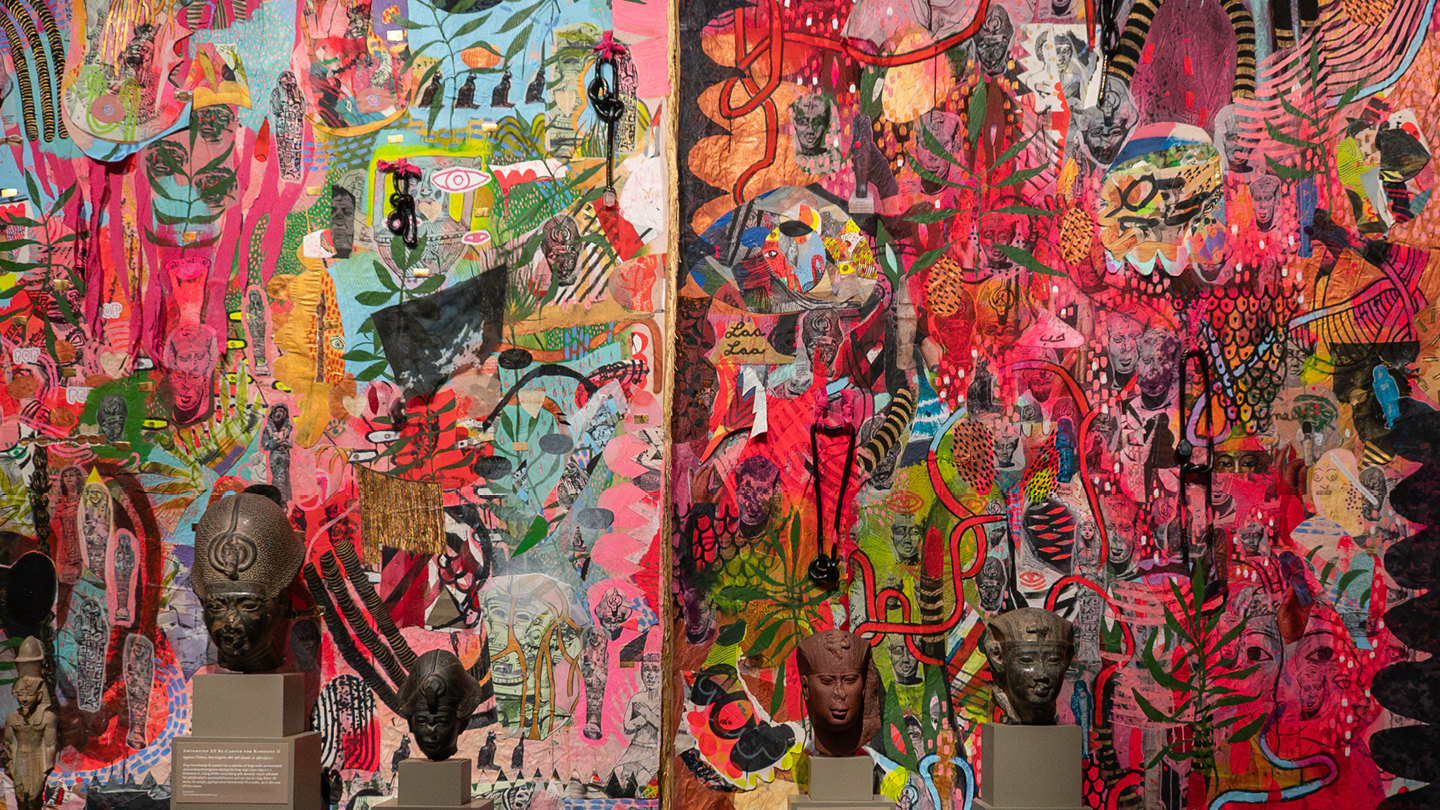
It’s just the beginning of the mixed-media artist’s work commissioned by the Walters Art Museum, which will be installed in the museum’s Ancient Egyptian gallery. By the time it goes on view in late March 2025, the canvas will be composed entirely differently than it is at this present moment, having grown to accommodate additional layers of materials and meaning. Jackie is an Egyptian- and Honduran-American artist who is known for her sprawling collages that delve into her past and present, and this work is no different.
Jackie grew up in Baltimore with a jeweler father and parents who encouraged her creativity from a young age. One of the ways her mother convinced her to attend church was the promise of a post-service art museum visit. Often, Jackie chose to wander through the Walters and its collections of antiquities from Egypt and the Americas.
“I have a real interest in exploring my own history in a micro and a macro sense, alongside history writ large and the context in which we’re all living today,” she said. “Understanding my multicultural Egyptian and Honduran heritage through museum collections is important to me, too. As a kid I would look at these ancient objects and think, ‘How does this relate to me and my family? Where’s the connection?’”
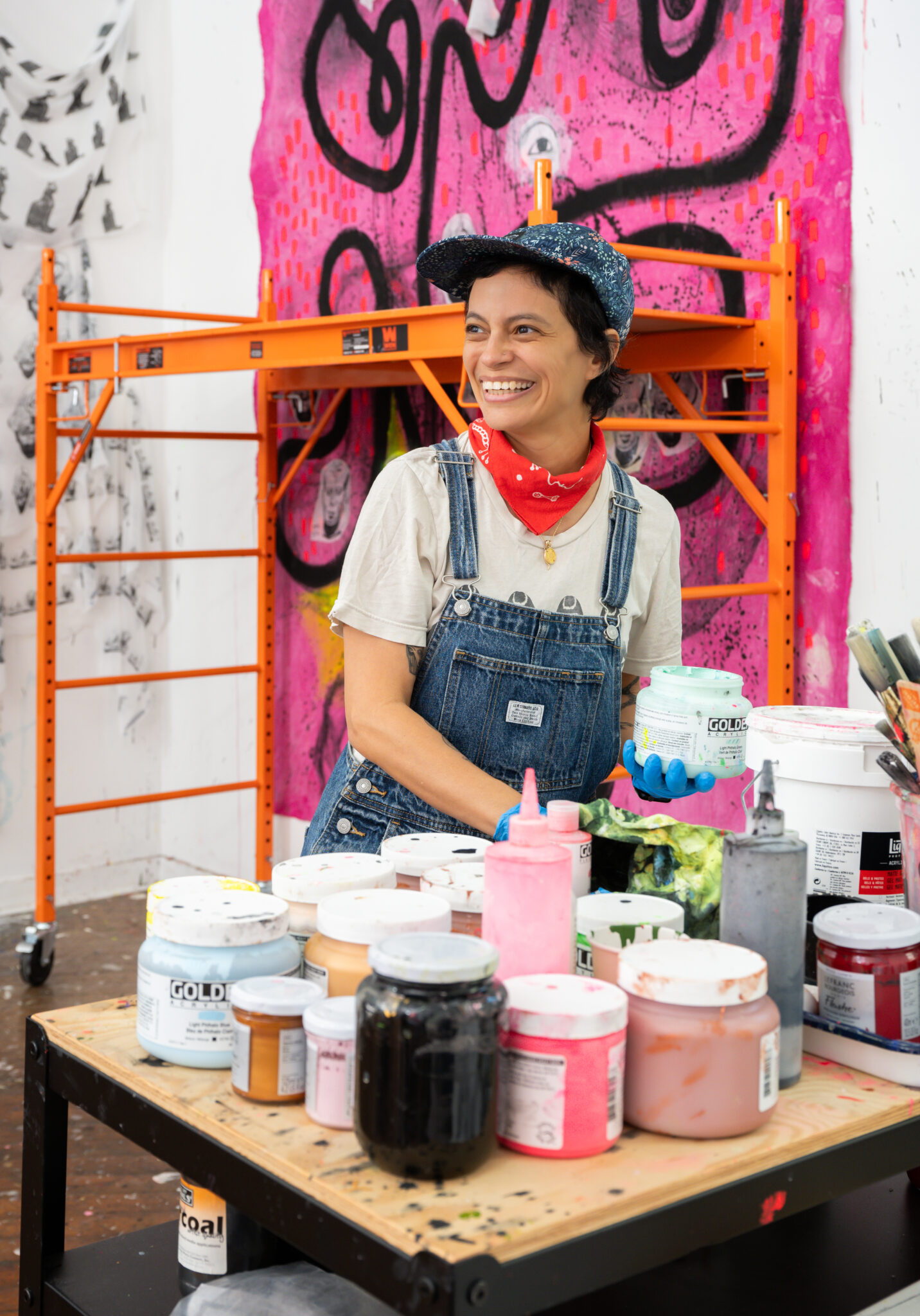
Artist Jackie Milad works on a large-scale collage in her Baltimore studio.
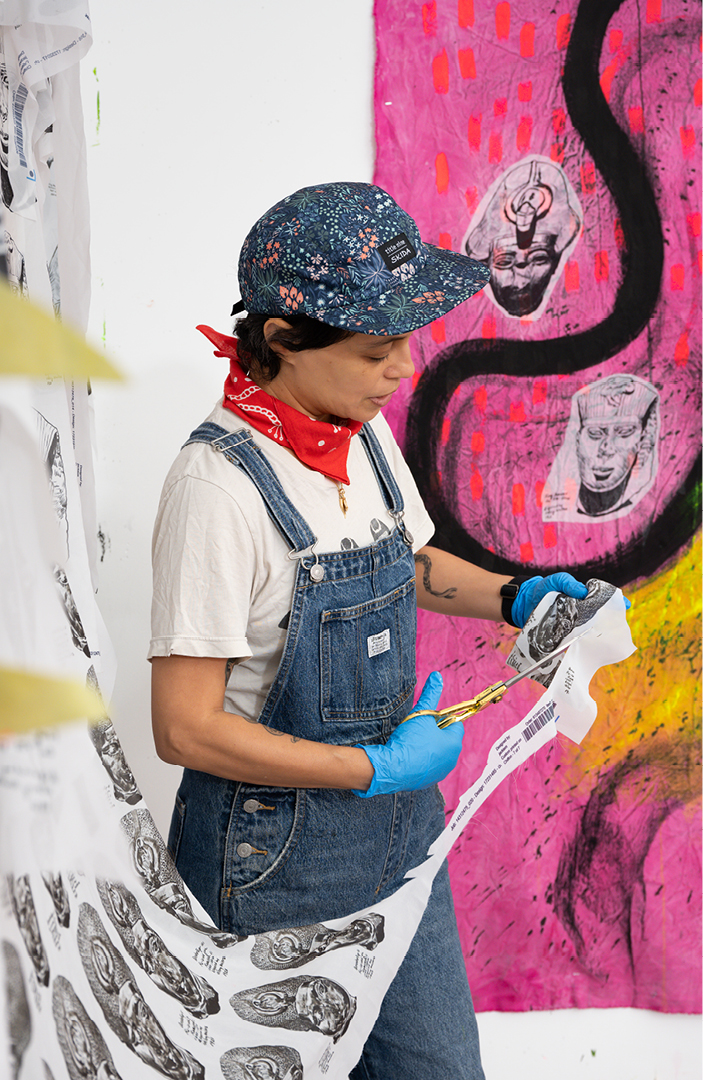
Artist Jackie Milad works on a tapestry collage that will be installed in the Walters’ Ancient Egyptian gallery in March.
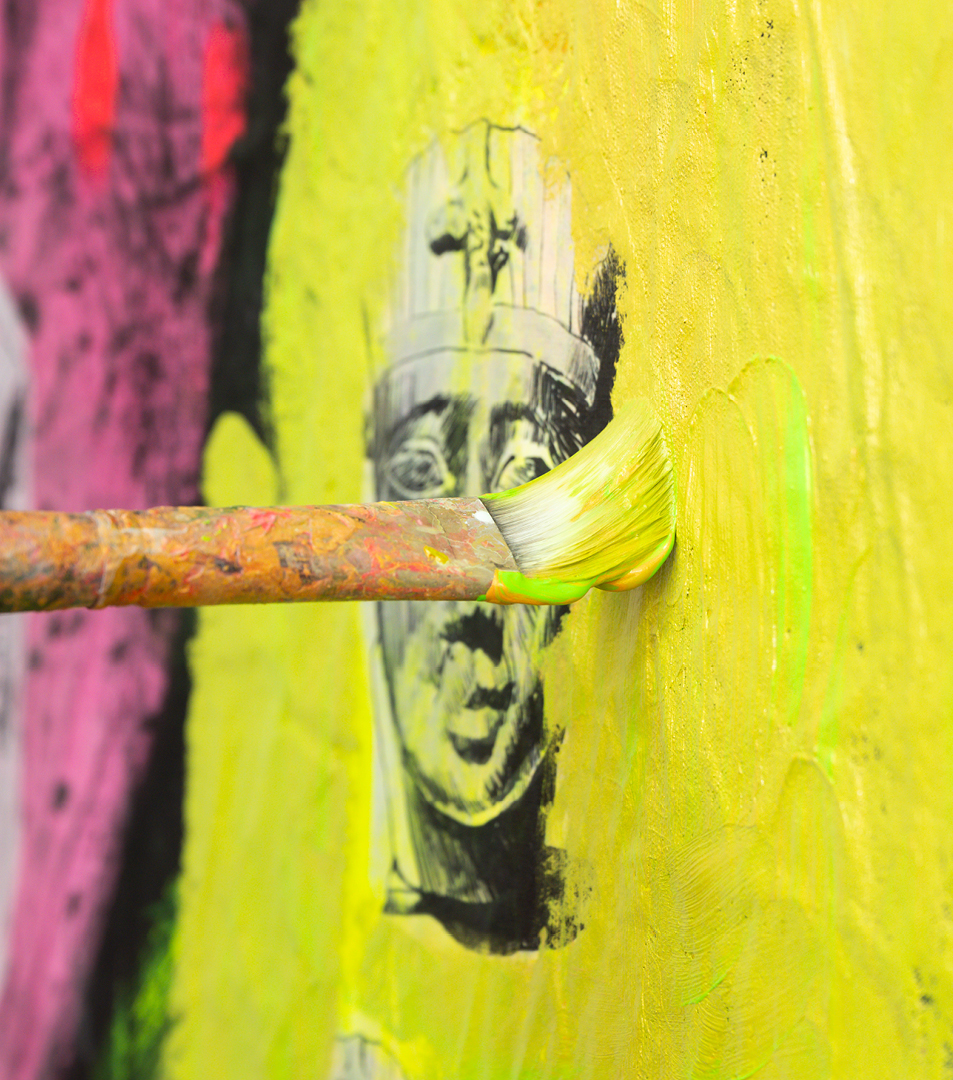
Artist Jackie Milad works on a tapestry collage that will be installed in the Walters’ Ancient Egyptian gallery in March.
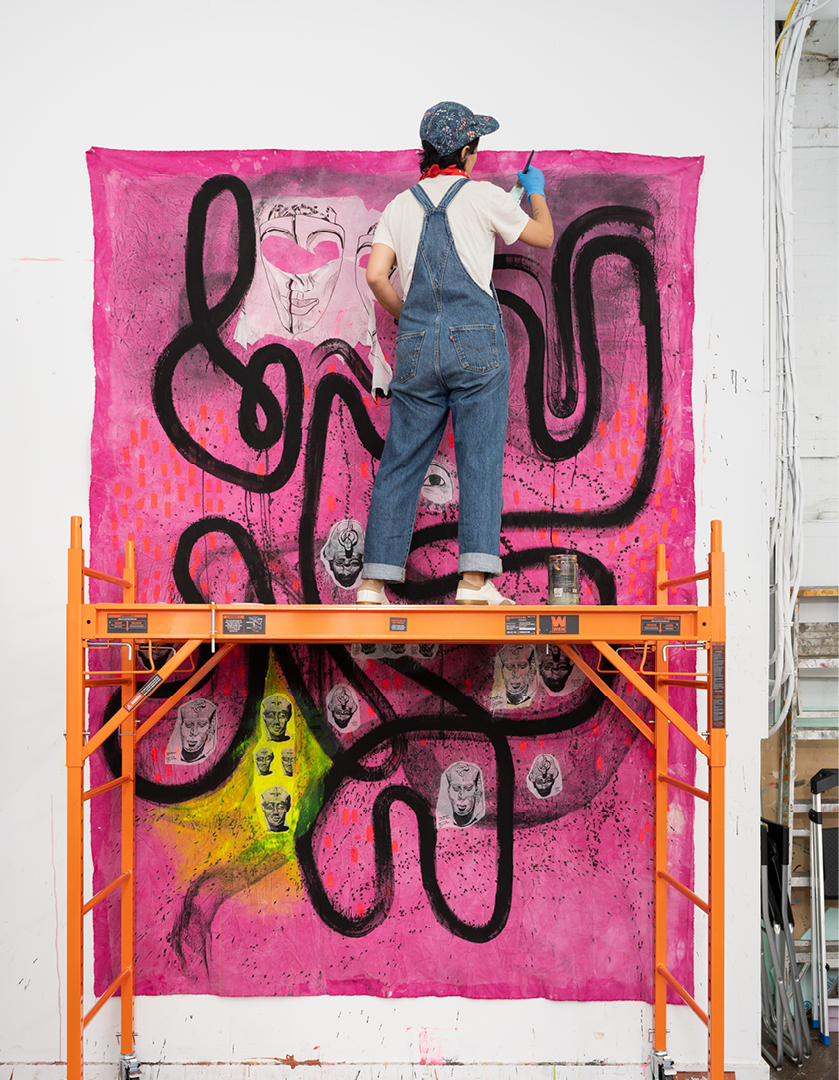
Artist Jackie Milad works on a tapestry collage that will be installed in the Walters’ Ancient Egyptian gallery in March.
Jackie earned a BFA from Tufts University and an MFA from Towson University. There, she practiced minimalist figure drawing—a style that contrasts greatly with her expansive, maximalist works.
“After some time passed, I started to look at the old drawings in my archives and questioned why I was keeping them,” said Jackie. “I started cutting up those older works and using them as material to create these layered collage pieces.” In the infancy of this style, Jackie relied on only paper to create these works but, realizing its instability, she swapped paper for canvas. It was then that her tapestry-style collages came to life. This sturdy foundation gave the artist—a self-described omnivore of materials—the opportunity to go a step beyond what she’d made in the past.
“Now I take sort of a chaotic, maximalist approach to my work. It creates this sense of unease in the viewer,” Jackie said. “I think we can all relate to this feeling of overstimulation, of too much information, of our history—past, present, and future—all happening all at once.” Despite the chaos during creation, the starting point for Jackie’s work is singular: research. On the hunt for inspiration and direction, she sifts through archives, converses with archaeologists and museum curators, and sketches in museum galleries. This research has taken her near and far: to the British Museum and the Petrie Museum in England, as well as the Walters, each for a closer look at Egyptian antiquities.
When she moves into the studio to create, Jackie approaches her work freely. The only plan she goes in with is size. “When I think about the scale of Egyptian history, for example, to me that is incredibly overwhelming, so my work is sized to fit that. Ultimately, I’d like [my works] to be even bigger. There’s a lot of power in scale. And as a Brown woman, a child of immigrants, I want to take up a lot of space,” Jackie said.
“My work tells a story that’s really personal.”
Jackie’s large, colorful, multilayered collages can take months to build. She intuitively adds layers as she goes, cutting, sewing, painting, and gluing things together to build up a tapestry of materials and ideas. She gravitates toward neon pink and red, as well as objects that are shiny, tactile, and bright. Any material that inspires her is fodder for her art: She’s used everything from chiffon printed with her sketches of Egyptian antiquities to jewelry made by her father and drawings produced by her son. Fringe, canvas, paint, and paper also frequently appear in her work. The sketches embedded in the work shown here depict objects from the Walters collection.
She trusts her mark making and her process, confident that the work will get to a place where she will ultimately be happy with it. Until she is, she’ll continue to freely cut it up or add to the work. The process itself connects back to history, bringing her work full circle. The collages that Jackie creates are historical documents in and of themselves, partly because they reference the antiquities that she studies at museums, and partly because they are layered with older, cut-up artwork, which are a reference to her own personal history.
“When I was a child visiting the Walters, there was no narrative to connect the ancient objects to my family. My work tells a story that’s really personal, and I hope that another child comes in and sees it and thinks, ‘I understand this. This is a part of my life. We’re related here,’” she said.
In recent years, Jackie’s work has gained significant recognition. In 2019, she was named a Janet & Walter Sondheim Prize Finalist, for which she exhibited her work in the Janet & Walter Sondheim Artscape Prize Exhibition at the Walters. She’s also a multiyear recipient of the Individual Artist Grant from the Maryland State Arts Council, a Creative Capital Grantee, and the inaugural Robert W. Deutsch Foundation’s Alumni Rubys Artist Grantee.
“The time is right to welcome one of Jackie’s impressive collages, which she imbues with meaning and personality, to our Ancient Egyptian galleries,” said Gina Borromeo, Interim Director. “Her layered, research-based approach will uncover unexpected nuances within our collection, and the piece’s vibrant textures and colors will provide a counterpoint to see our antiquities in a new light. Displaying the work of a local artist here at the Walters is an impactful way to bridge the divide between our visitors of the present and makers of the past.”
This installation is generously supported by The Boshell Foundation / Betsey and David Todd.