The Walters at Ninety
Published Fall 2024
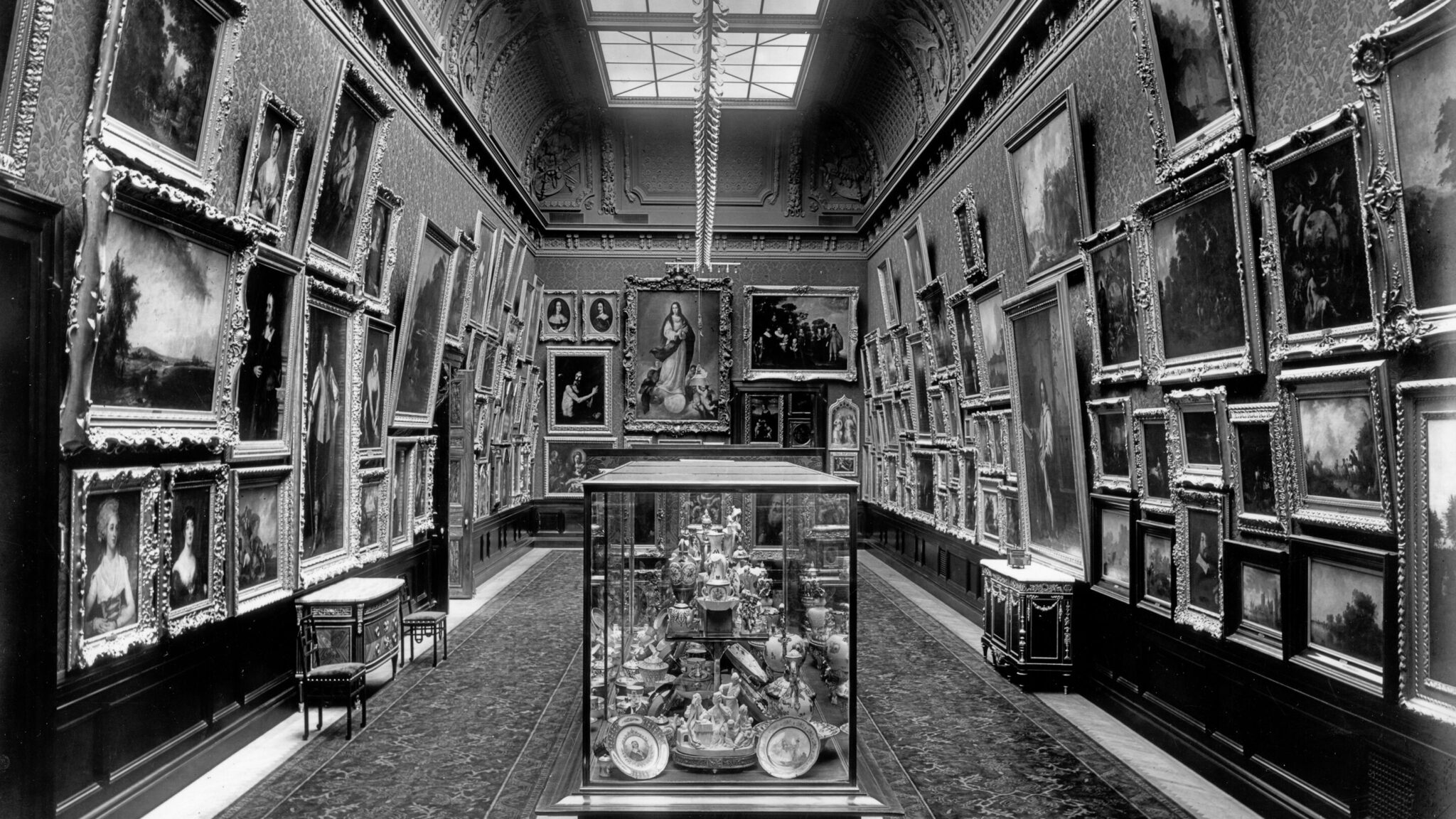
The Walters family art collection lines a gallery in the Palazzo building, circa 1909.
The Walters Art Museum is among America’s most distinctive museums, forging connections between people and art that spans seven millennia from cultures around the world. This fall, the Walters will reach a celebratory milestone: 90 years of operation as a public cultural institution in Baltimore.
“It has been an honor to engage and serve our visitors from the City of Baltimore, the state of Maryland, and around the world for the last 90 years,” said Michelle RhodesBrown, Interim Co-Director. “Thanks to ongoing support from our board, staff, volunteers, and supporters, we look forward to maintaining the Walters Art Museum as a free, welcoming, and accessible environment for all to experience art from across the globe for the next 90 years and beyond.”
Since our opening in 1934, the Walters has not wavered in its mission to bring art and people together for enjoyment, discovery, and learning. However, many things have changed at the Walters as we’ve expanded our campus, collections, and reach. In honor of this anniversary year, we’re looking back at some key moments of growth and change in the history of the Walters Art Museum.
The Foundational Years
The foundations of the Walters predate the museum’s official opening. William T. Walters (1819–1894) amassed a large private art collection that his son, Henry Walters (1848–1931), continued to grow. In 1874, William began a tradition of opening his home on West Mount Vernon Place for a few months each year so the public could view his collection. Proceeds from the ticket sales benefitted the Baltimore Association for the Improvement in the Condition of the Poor.
Soon, the collection outgrew its space in the Walters home. In 1905, Henry began construction on a distinctive building on Charles Street to house the artworks. The building’s interior was modeled after a 17th-century palace, or “palazzo,” from Genoa, Italy, while the exterior was inspired by the Hôtel Pourtalès in Paris, France. When the Palazzo building opened in 1909, Henry continued his father’s tradition of fundraising for those in need by selling tickets to view the collection.
Upon his death in 1931, Henry Walters bequeathed his entire collection of more than 22,000 works, the Charles Street building, his adjacent townhouse at 5 West Mount Vernon Place, and the land they sit on to the City of Baltimore “for the benefit of the public.” The gallery was closed throughout 1933, then reopened on February 2, 1934, providing Baltimoreans a final opportunity to view their favorite works of art installed as Henry Walters intended. After organizing the collection, making necessary renovations, and hiring a small staff, the Walters Art Gallery formally opened to the public on November 3, 1934.
-
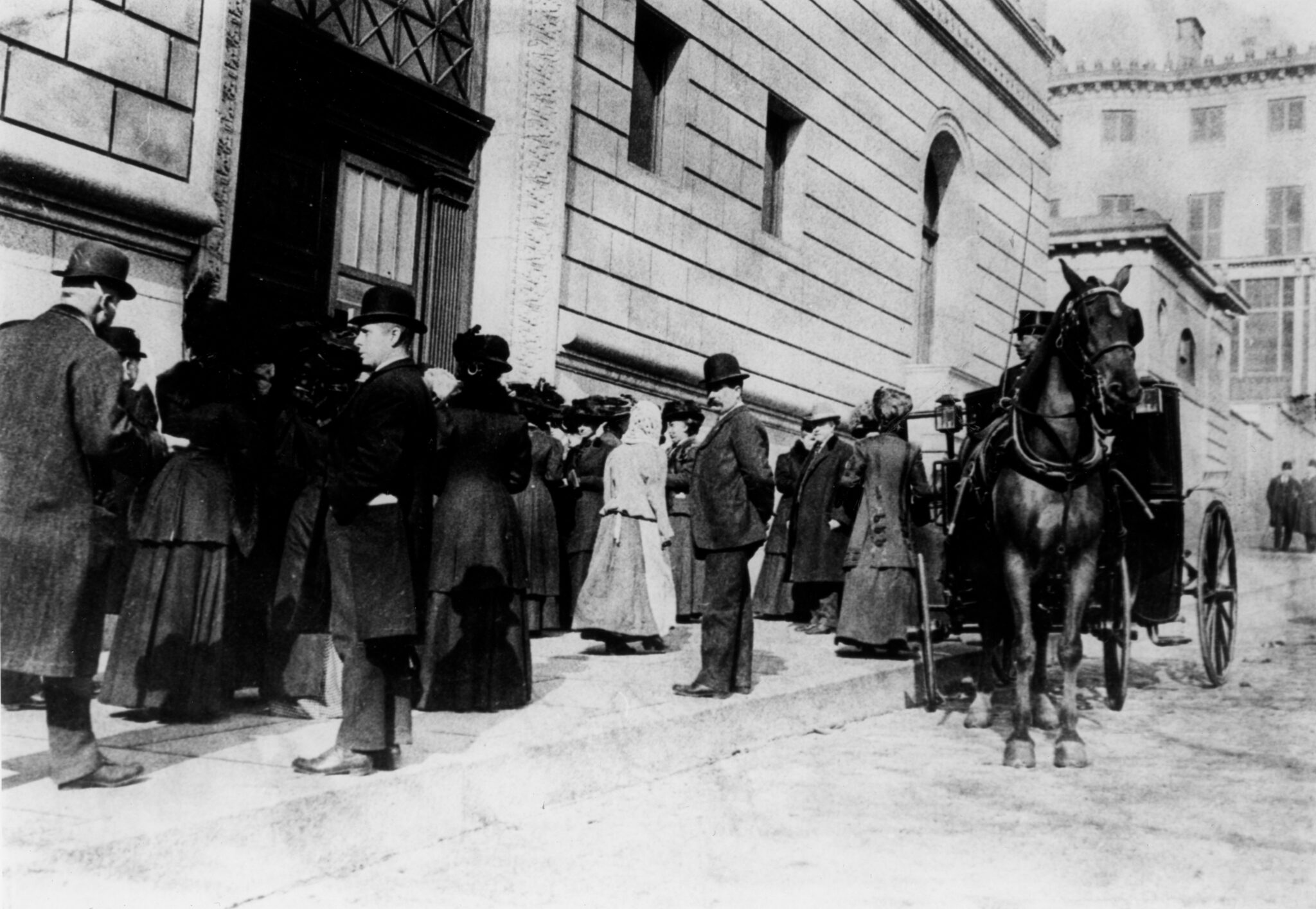
Opening day of The Walters Art Gallery, 1934.
-
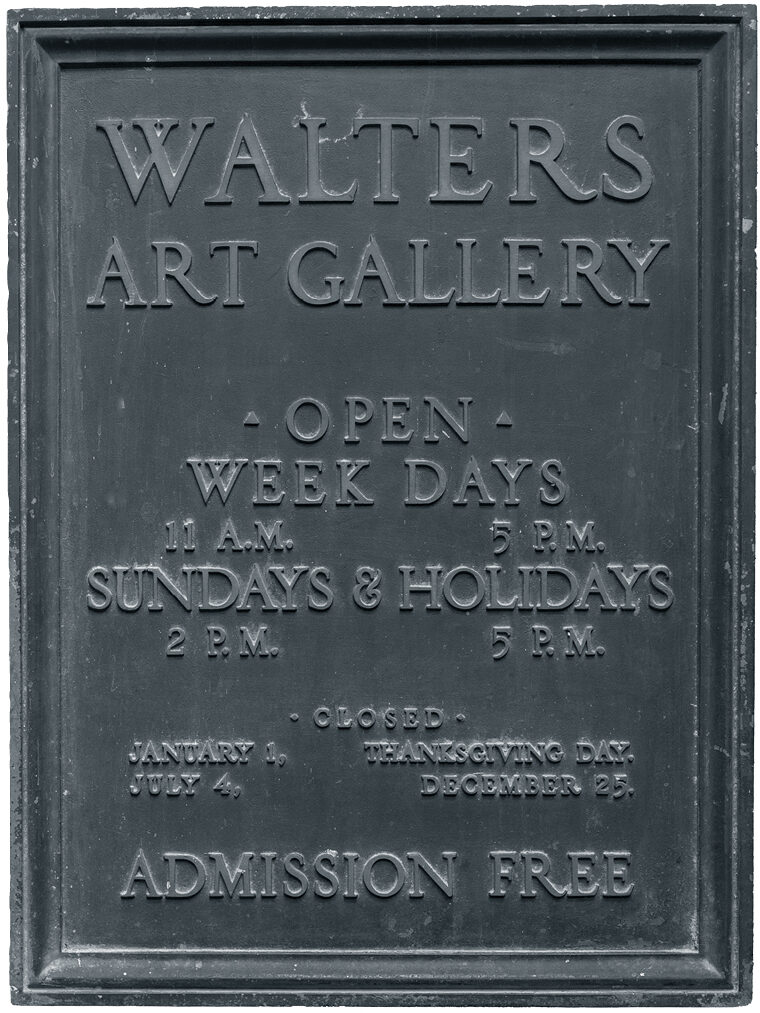
An early plaque from the exterior of the Palazzo building advertises the museum’s opening hours.
-
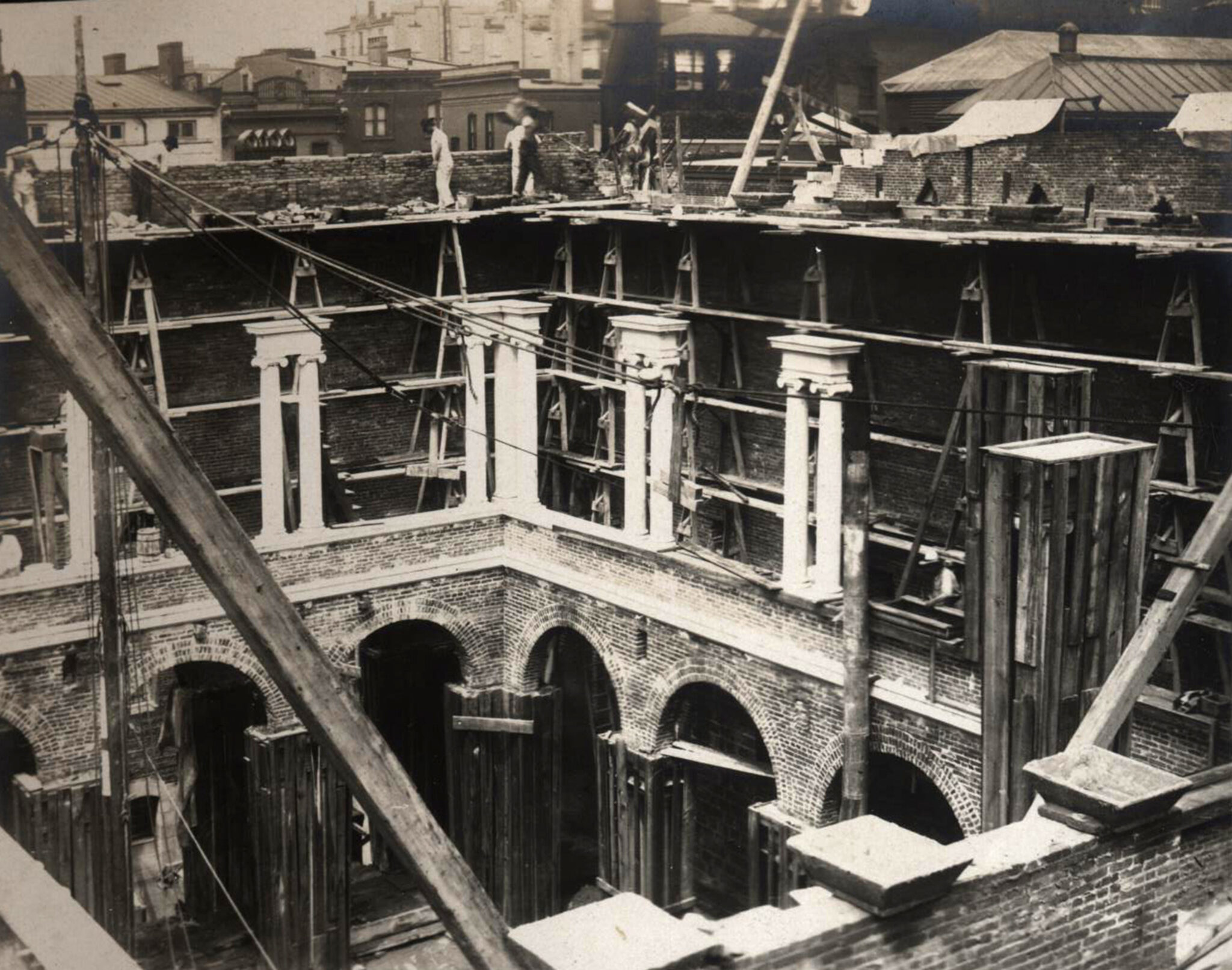
The Palazzo Building’s Sculpture Court under construction, 1908.
-
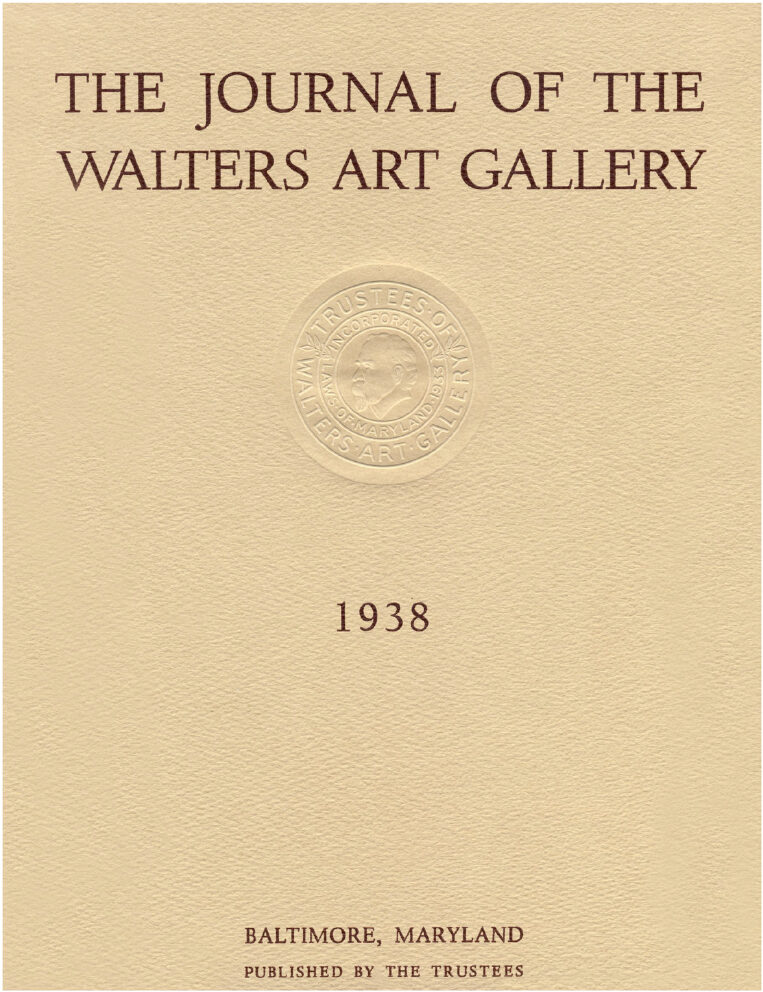
The first edition of The Journal of the Walters Art Gallery, published in 1938.
-
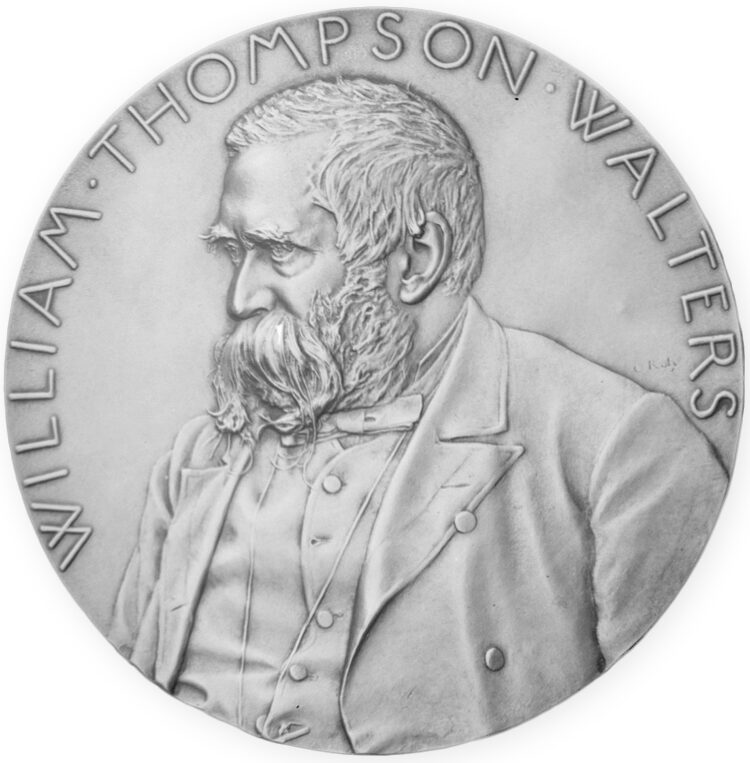
Louis-Oscar Roty, Portrait of William Thompson Walters,
ca. 1894. The Metropolitan Museum of Art. -
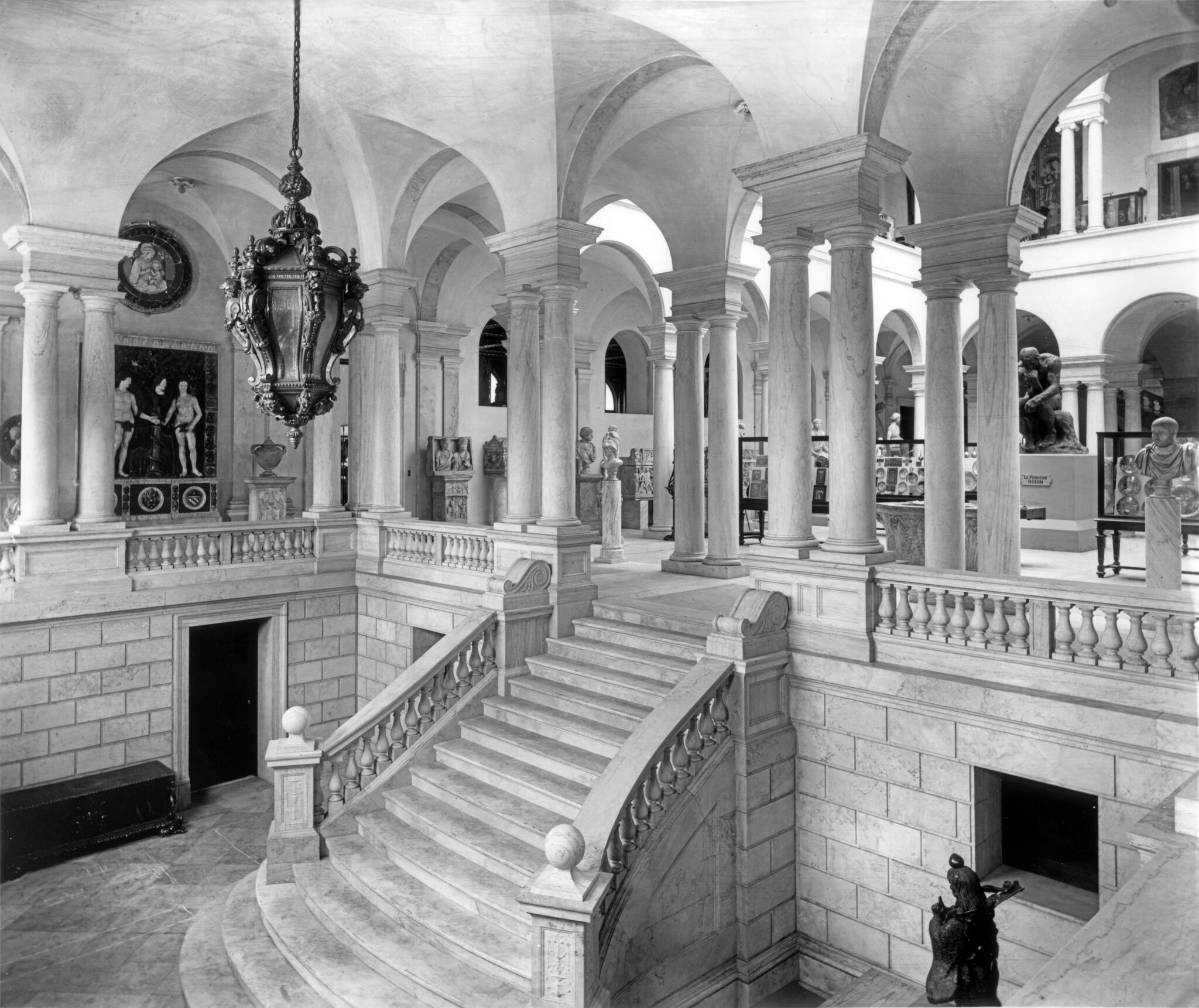
An early photo of the Palazzo building’s stairs leading to the Sculpture Court.
-
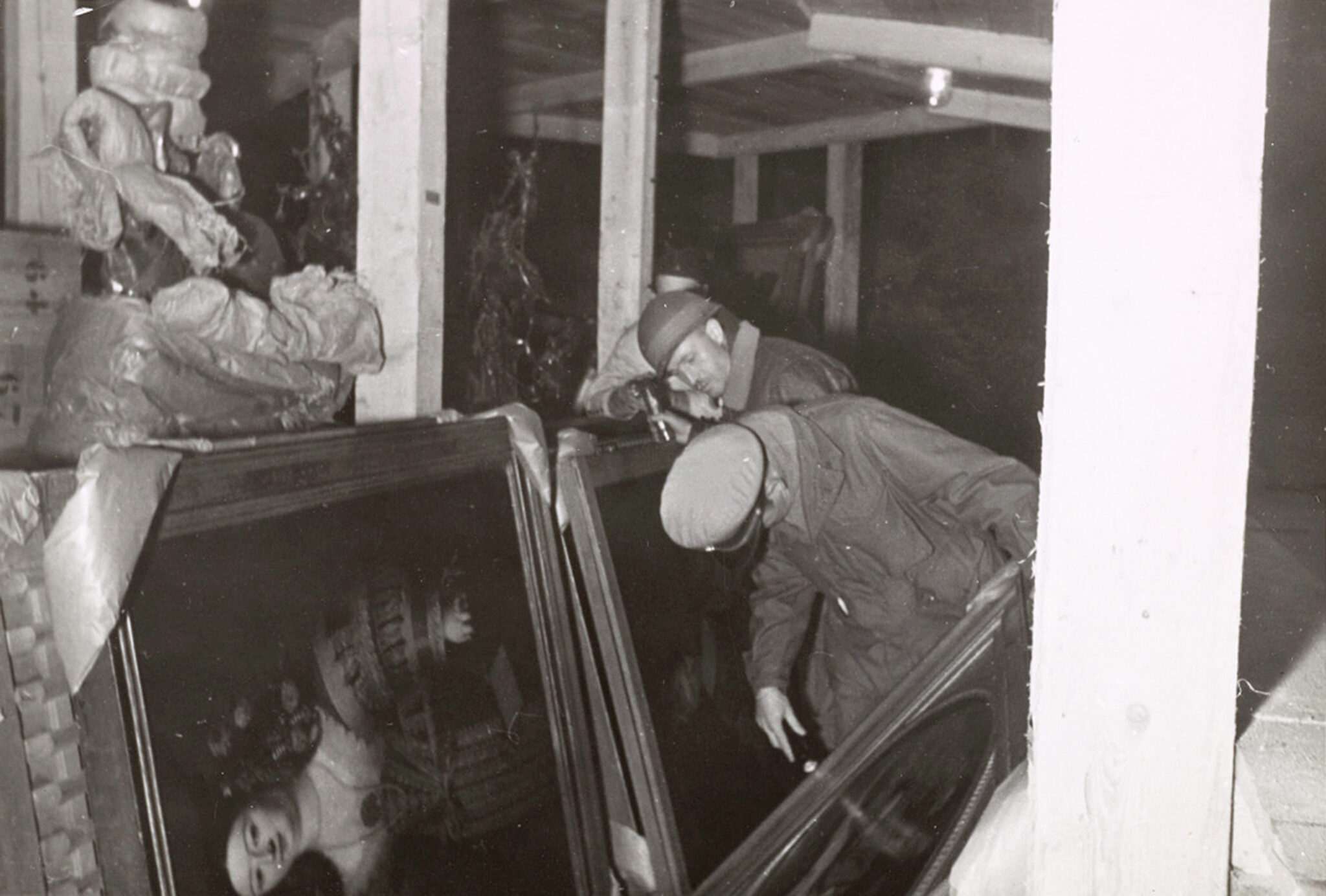
Members of the Monuments, Fine Arts, and Archives Section Unit inspect paintings on July 9, 1945. Archives of American Art, Smithsonian Institution.
The Early Years
The museum’s attendance steadily increased from the time of its opening, jumping from around 34,000 annual visitors in 1937 to nearly 50,000 visitors in 1941. However, at the end of 1941, America entered World War II, causing a drastic change in museum operations. The museum never shuttered during the war, but several objects that were considered irreplaceable treasures were removed for safekeeping and sealed inside the Frederick Armory’s underground swimming pool in Frederick, MD, for the duration of the war.
Many museum staff members served during the war, including Marvin Chauncey Ross (1904–1977), the Walters’ first curator of Byzantine, medieval, and decorative arts. Ross enlisted in the U.S. Marine Corps and later became part of the Monuments, Fine Arts, and Archives Section Unit, colloquially known as the “Monuments Men.” Among other accomplishments during Ross’s 18-year tenure at the Walters, he contributed significantly to The Journal of the Walters Art Museum. Launched in 1938, it is one of the oldest continuously published scholarly art museum journals in the United States.
Despite the challenges of World War II and its aftermath, the Walters quickly became known as one of America’s premier art institutions. The museum was particularly noted for its collection of medieval art and manuscripts, which were both highlighted in the Walters’ earliest major exhibitions. The first, Early Christian and Byzantine Art, was presented in collaboration with the Baltimore Museum of Art (BMA) in 1947 and brought together more than 1,000 objects from public and private collections. This exhibition was followed by Illuminated Books of the Middle Ages and Renaissance in 1948, another collaboration with the BMA that provided a comprehensive review of illuminated manuscripts in America.
The Expansion Years
As America recovered from World War II, the Walters expanded exponentially, welcoming a growing number of visitors and increasing its staff and offerings to keep pace with demand, including radio and television programs, lectures and classes, concerts in the galleries, and more. Educational visits to the Walters became a staple of the school-going experience in Maryland. In 1946 alone, more than 20,000 children visited the galleries. More recently, the focus has shifted to family participation at the museum. From 2006 to 2015, there was an 89 percent increase in families engaging with educational programs like Art Carts, family festivals, guided tours, and drop-in art activities.
The Women’s Committee of the Walters Art Museum was established in 1963 with a mission to “create goodwill for the museum.” Beginning with 12 determined founders, the Committee grew to nearly 100 members at its peak and donated gifts in excess of $2 million to the museum. In 2021, the committee also created the Walters Women’s Committee Legacy Endowment, which continues to support the museum’s exhibitions and education programs.
Although the committee sunset in 2021, women have been a driving force behind the work at the Walters since the beginning. Several members of the original staff were women, including Dorothy Kent Hill (1907–1986), the museum’s first curator of classical art; Winifred Kennedy (1902–1994), the museum’s first registrar; and Dorothy Miner (1904–1973), the first librarian and keeper of manuscripts, who worked at the Walters for an impressive 39 years.
The Walters’ Conservation and Technical Research department has also been helmed by female leaders for much of its existence, most notably Elisabeth Packard (1907–1994) and Terry Drayman-Weisser. Founded in 1934, it is the third-oldest museum laboratory in the country and is also marking its 90th anniversary this year. The conservation team has often been at the forefront of discovery, as in the case of The Archimedes Palimpsest. The oldest surviving copy of works by the greatest mathematician of antiquity, this incredible object was loaned to the Walters for conservation, imaging, and study in 1999. Over 12 years, the team worked diligently to reveal and decipher its original text, saving the book’s contents from oblivion.
-
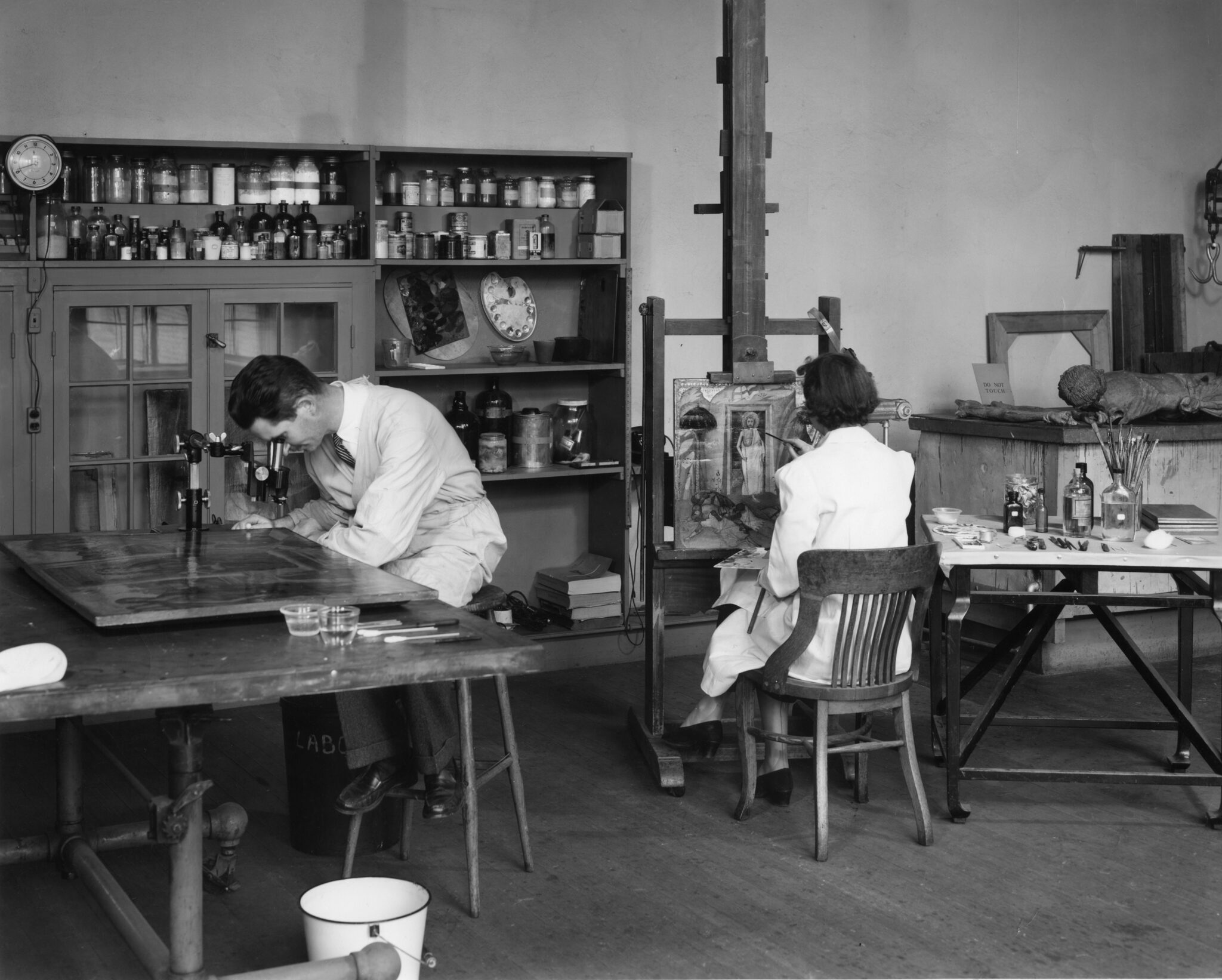
Jack Kirby and Elisabeth Packard in the Conservation Lab, undated
-
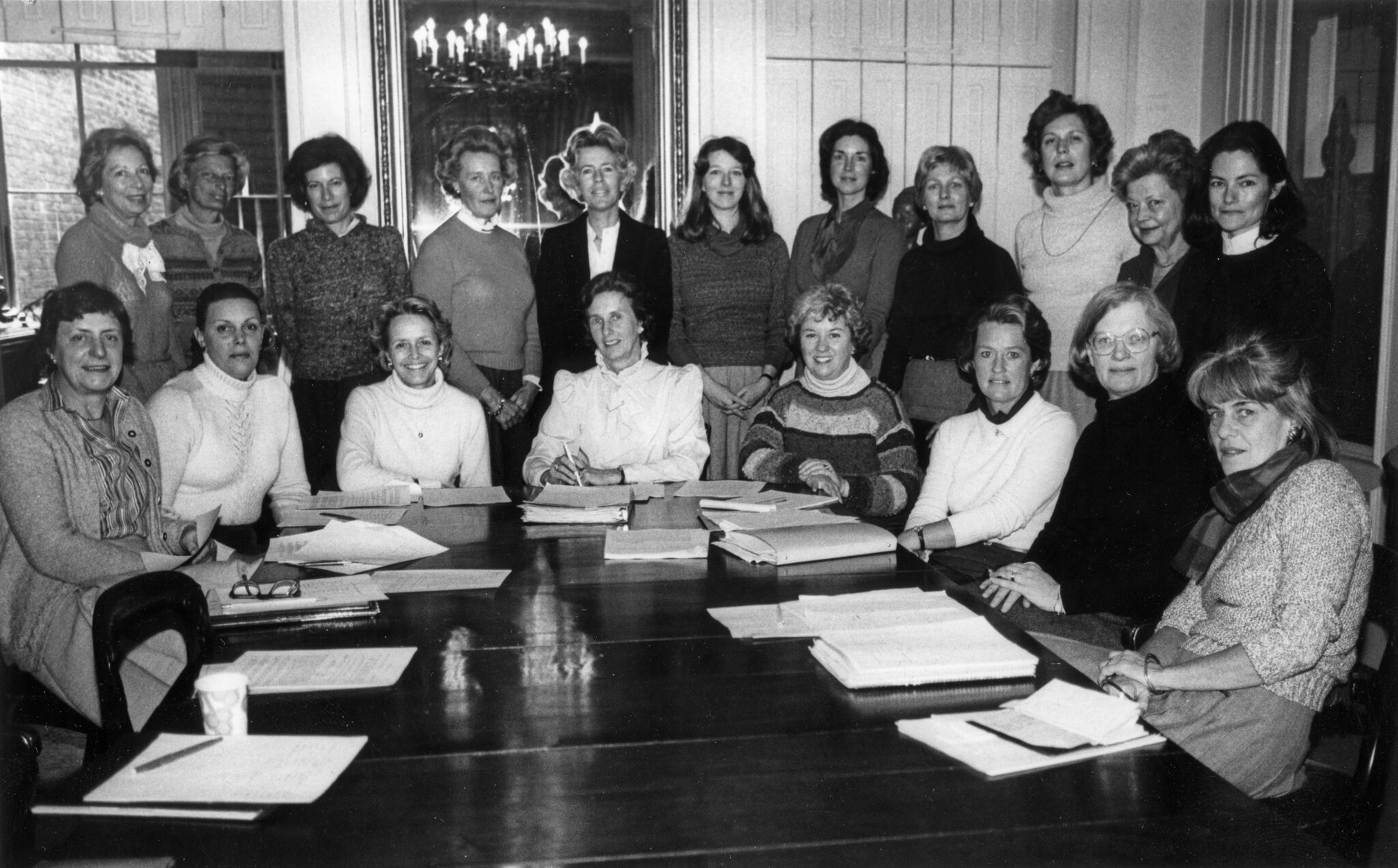
Group photo of the Women’s Committee, 1983. Back Row (L to R): Rosalee Davison, Jody Harvey, Liz Jones, unidentified, Joan Garland, Beverley Young, Carol Barton, Pat Barrett—museum liaison, unidentified, Jean Speed, Terry Ulmer. Front Row (L to R): Merle Phillips, Jean Geesey, Teensa Williams, Helen Passano, Nancy Belcher, Leonie Simmons Gately, Jean Sharpless, Ellie Kelly.
-
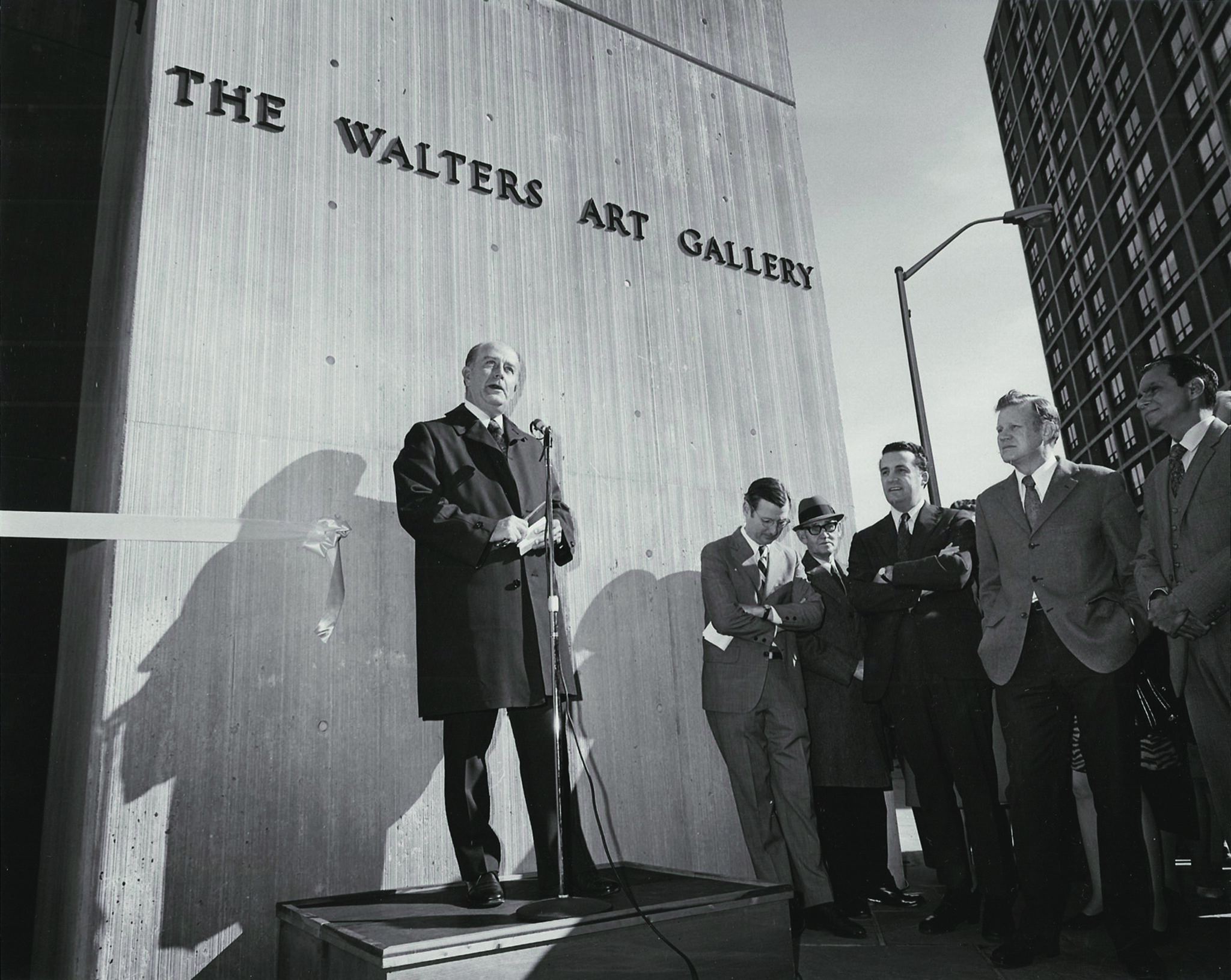
Baltimore Mayor William Donald Schaefer speaks at the opening of the Centre Street building, 1974.
-
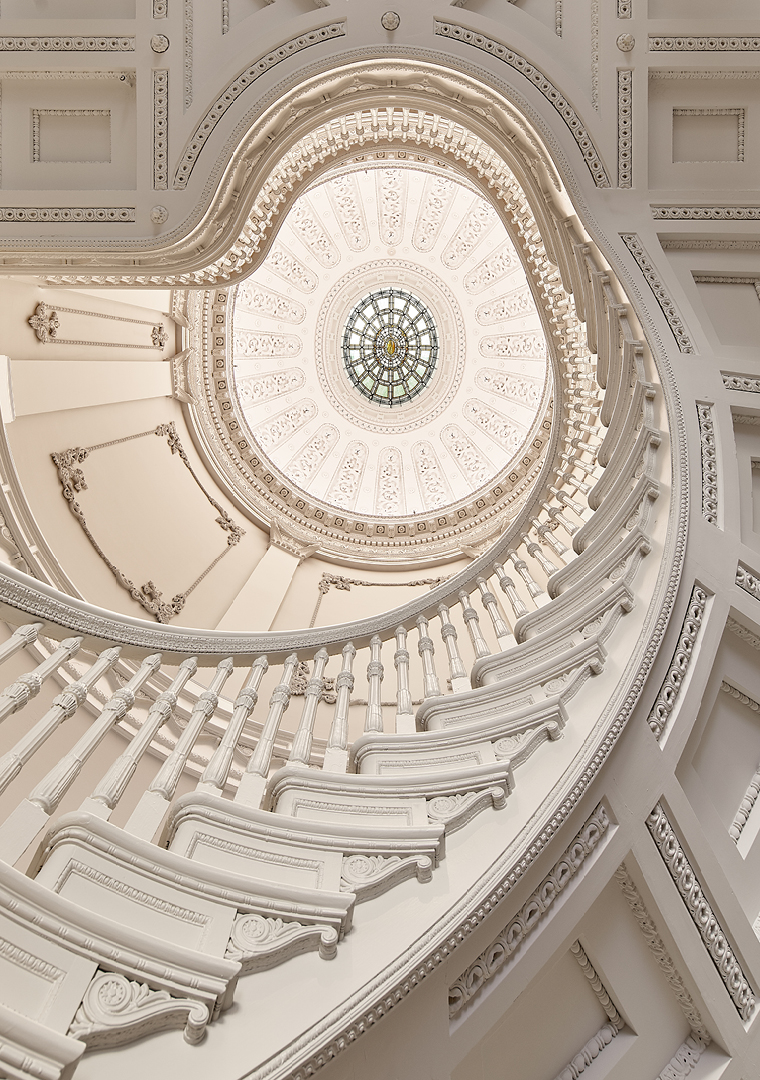
The spiral staircase in the recently renovated Hackerman House leads up to a skylight, thought to be from the workshop of Louis Comfort Tiffany. Photo by Jeffry Totaro.
The Open Access Years
In 2000, the institution formally changed its name from the Walters Art Gallery to the Walters Art Museum, a shift that reflected the museum’s expanding role as a major public institution. This change coincided with a commitment to increase access to the Walters. With support from the City of Baltimore and Baltimore County, the museum eliminated its general admission fee in 2006, leading to a 45 percent sustained increase in visitors over the first ten years, to more than 200,000 visitors a year in 2015.
In 2011, the Walters took its commitment to open access further, removing restrictions for more than 10,000 images of objects in the museum’s permanent collection, which can be used by the public for any purpose, free of charge, under a Creative Commons license. This action ushered in a new era of digital open access to our collections that has been replicated by other institutions around the country. In 2015, the museum also removed admission fees for special exhibitions, making the Walters truly free for all.
The Walters’ permanent collection continued to grow over time, through both gifts and acquisitions made to broaden and diversify our holdings, necessitating the need for additional exhibition space. The Brutalist-style Centre Street building opened in 1974, adding areas for both permanent and temporary exhibitions. And in 1985, Hackerman House became part of the Walters campus. Originally constructed circa 1848 and formerly known as the Thomas-Jencks-Gladding House, this stunning mansion located at 1 West Mount Vernon Place was donated to the city by Willard and Lillian Hackerman in 1984.
Then-Mayor William Donald Schaefer held a competition to determine the best use of the structure, and the Walters won with its proposal to convert the house to galleries to display its growing Asian art collection. Hackerman House first opened as part of the museum in 1991 and recently underwent a multiyear restoration that revealed the building’s original beauty, reopening in 2018. It is now one of five historic buildings that form the museum’s campus, displaying and storing our more than 36,000 works of art.
The Future Years
Ninety years in, the Walters Art Museum is looking ahead to the future. We recently opened Across Asia: Arts of Asia and the Islamic World, a landmark exhibition that brings together our core Asian and Islamic art collections for the first time, now on view in the Centre Street building. And in May 2025, we’ll unveil Latin American Art / Arte Latinoamericano, a permanent exhibition showcasing art from South, Central, and North America, including the Caribbean, in the newly renovated North Court galleries.
Throughout our nine decades, one thing has remained consistent: The foundation of our institution is the people who bring it to life. The Walters has been continuously sustained not only by its dedicated staff, board, supporters, and volunteers, but also by the members of its enthusiastic community. “The Walters is truly made special by our visitors—the people who walk through our doors each day to discover new perspectives by exploring the galleries, learning from lectures and public programs, attending festivals, and making art,” said Gina Borromeo, Interim Co-Director. “Whether you’re a longtime visitor or you’ve only been once, we look forward to welcoming you on your next trip to the Walters.”