

For many, the holiday season brings about feelings of nostalgia and hope. During this time of year, we nourish ourselves with tradition, spend time with loved ones, and seek comfort in its many forms. Art offers opportunities through which we can do each of these things, allowing us to experience and navigate this season with greater depth, warmth, and grace. In this episode, members of the Walters community delve into the ways art has made a meaningful impact on their lives.
Transcript
Free Admissions Season 2 Episode 6: Where Do You Find Comfort? | Transcript
[00:00:00] Will Murray, Lead Maintenance Technician:
‘Tis the start of December, and you’re descending the stairs.
When you open the door, there’s a chill in the air
And a bustle of people out filling the streets
With a buzz of excitement for friends soon to greet.
Shoppers rush past with their parcels clutch tight,
But your errand is different, one filled with delight,
For you’re on your way to take in some art
In your very own city, in Mount Vernon’s heart.
The Walters is where you’ll be spending your day,
For enjoyment and learning, and maybe some play.
The crunching of leaves underfoot lends some pep
As you hurry along with a bounce in your step
And before you believe it, on this day in late fall,
You’re entering the museum that has something for all.
You breeze through the lobby, and then on the right,
You stop by the Cafe to grab a quick bite.
A treat calls to you from the many temptations—
A sandwich and drink to fuel your explorations.
Then you’re off to discover what’s lying in store
In gallery upon gallery across many floors.
Soulful Creatures intrigues you, so inside you go
To learn about animal mummies and more.
These mysterious objects seem ancient and strange,
But the curator’s labels all help to explain
Why and when this Egyptian practice was used
To speak to the gods (and more, so they muse).
Next, the Medieval galleries contain many sights:
Stained glass windows and paintings and armor of knights.
Playful drawings of kittens leap and prance on the page
Inside Paws on Parchment—this show’s all the rage!
But these fanciful felines also teach quite a lot
About what’s good and bad in a world that is fraught.
The Sculpture Court’s haven is where you next stop,
Where columns of marble provide a backdrop
For taking a break or for trying your hand
At art-making projects detailed or grand.
You sit down for a moment to craft wearable art
For the person you love, one who touches your heart.
Then you step through a doorway to far away places
Where Latin American art lines the cases
In colors and textures both subtle and bold.
This new exhibition is a sight to behold!
But the day has drawn on. Other tasks called to you.
And sadly, there’s other things now you must do.
But you smile as you walk toward the entrance again,
Because soon you’ll return, perhaps next with a friend!
A gallery officer bids you farewell
As you head for the door, down the court’s grand stairwell.
And as you step out once again to the cold
You think, “What a grand day, much better than gold.”
Then you nod and you smile as you turn out of sight
And say “Thank you so much, and have a good night!”
[00:02:54] Karena Ingram, host: Welcome to Free Admissions, the Walters Art Museum podcast, where we bring art and people of every background together to inspire creativity, curiosity, and connection.
I’m your host, Karena Ingram, and that warm, welcoming voice you just heard belongs to Will Murray, our Lead Maintenance Technician. It feels like the perfect way to begin an episode titled “Where Do You Find Comfort?”, where our conversation today is wrapped in the cozy, heartwarming feelings that art can spark, especially during the chill of winter.
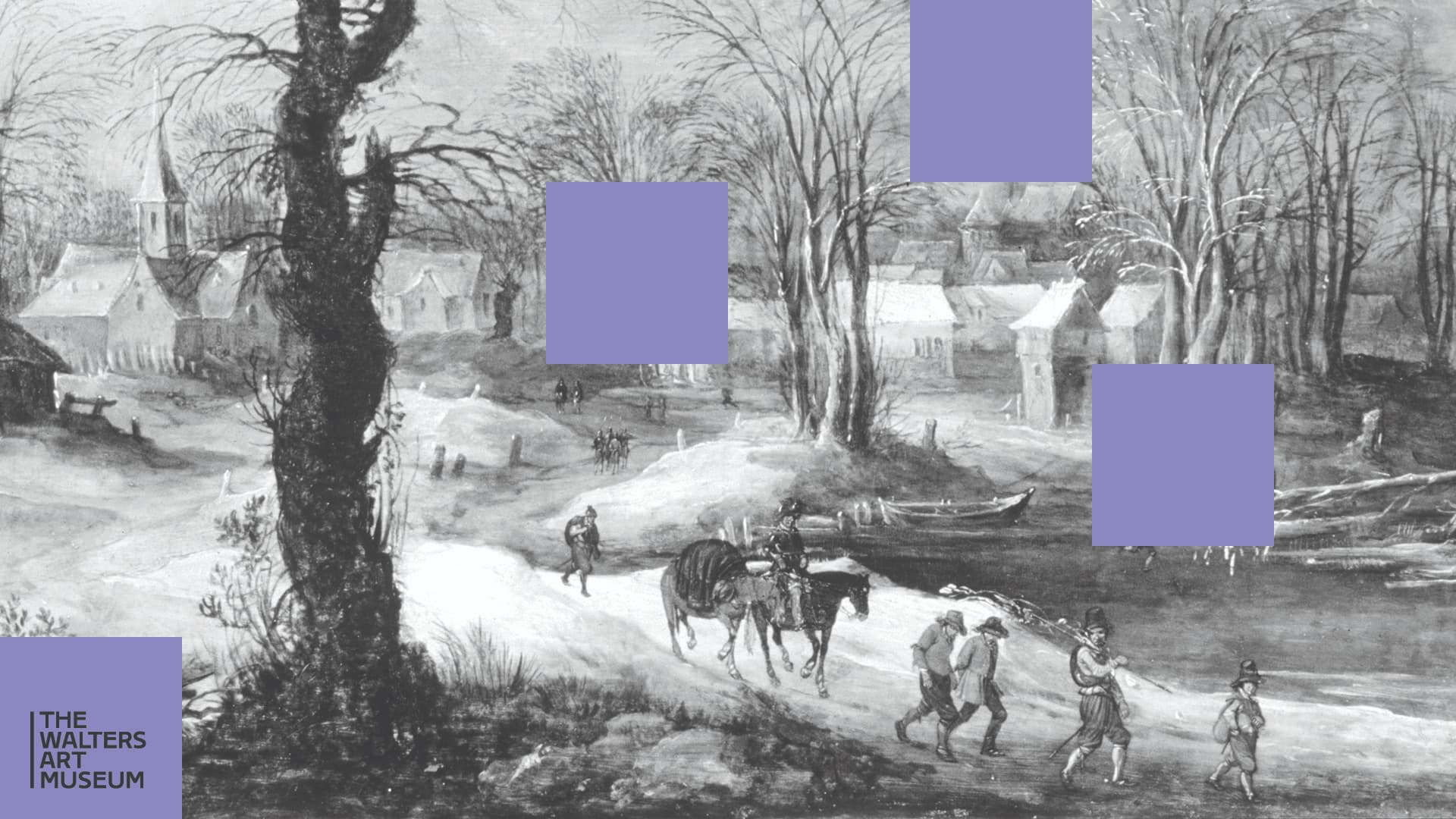
For example, if you’ve ever been in our Chamber of Wonders, you might have paused in front of a painting of a snowy winter landscape by artist Joos de Momper the younger (1564-1635). With every brushstroke, he perfectly captured a crisp, cold European landscape detailing a frozen river bank, bare branches, and town folks milling about on top of a blanket of snow.
Whenever I stop and take in that painting, I’m reminded of how comforting it feels to be surrounded by art. To find warmth and stillness within these galleries, even as the temps outside grow colder. There’s so many things throughout the museum that bring that same sense of welcome and wonder. Maybe one just came to mind for you.
In this episode, we’ll hear from the people who make the work possible here at the Walters. Their memories, their reflections, and the unique ways they find comfort in our museum.
No tickets necessary. Free Admissions starts now.
[00:04:19] Elizabeth Norman, Assistant Manager of Gallery Experience: My name is Elizabeth Norman. I’m the Assistant Manager of Gallery Experience and Interpretation, and I’ve worked at the Walters for a little bit over seven years now. One piece that I visit every now and again is pretty small. It’s tucked away in our ancient treasury, and it might take a bit of looking to find it.
It’s a pendant, almost heart shaped, smaller than the palm of your hand. The piece is made out of gold with a delicately raised image of a boy with wings at the center, and there’s a lot of detail, especially for such a tiny piece. You can see his hairstyle, the wavy stripes on his tunic, and individual feathers on his wings, which makes me so impressed by the skill of the artisan who made this piece and the time they spent making it just right.
This object was part of a practice in some areas of the Mediterranean where infants would be given special necklaces, amulets, to protect them from the evil eye and other dangers that could threaten their survival. This piece is a high-status example as it’s made out of gold, but clay, wood, or other metals were used to create more modest pieces. When the child reached cultural adulthood, it was sometimes a rite of passage to give up that amulet as an offering, as they left their childhood behind and took on adult responsibilities in society.
This piece was made in the Etruscan culture around the fifth century BCE. Etruscans were neighbors to the early Romans, with their own distinct language and beliefs, though there is some overlap in mythology with cultures that we might be more familiar with. The way it’s displayed in the case, we can only see one side, the winged youth, but both sides were decorated. And there’s an inscription that tells us who this boy and the other figure on the back of the pendant are: Vikare and Taitle, which is badly pronounced old Etruscan for Icarus and Daedalus. A lot of people have heard the Icarus myth, and it’s still the source for some of our references today, including my favorite example, “girlbossing too close to the sun,” but essentially, it’s about a father and son escaping from imprisonment by using wings made out of wax and feathers to fly away.
Daedalus, the father, warns his son, Icarus, to be careful, but Icarus is so exhilarated by flying that he goes as high as he can. The sun melts his wings and he ends up falling into the sea and drowning. And I know that that doesn’t exactly sound like a heartwarming story to focus on. It’s so sad. But knowing just a little bit about what this object is and what it’s intended to do, I find it incredibly moving.
There’s just enough here to let your imagination reach out to the people who had this made. Like, this is a story about relationships carefully represented on a gold amulet, meant to be given by parents to a child that they clearly cared about. You can begin to imagine what they were thinking, what they were trying to say, what this might have meant for them, and we’ll probably never know for certain, but I think you could interpret this message in a lot of different ways.
There’s definitely a version that’s like, “Listen to your parents and don’t make risky decisions, or you’ll end up like blah, blah, blah.” But I also think there’s another way to read it, as an acknowledgement that there’s so much out of a parent’s control. And that there’s this deep desire to see your child spread their wings and live a life of their own, to make it to adulthood as protected as possible, and I think that feels very recognizable.
I think it’s easy to distance ourselves from ancient people and to focus on how different they are from us, which in some ways is fair. There has been so much change in the last five years, let alone the last thousand or two thousand or more. Our contexts are different. Our day-to-day lives look different. No one in ancient Etruria had to figure out how to log onto a Zoom meeting.
But they were living their lives with the same brains and hearts that we have. And most people wanted the same things that most of us want today, too: to live our best lives, however you define that, and to provide for the comfort and safety of the people that we care about. I think these are deeply human impulses that connect us across time and culture and difference, and I think it’s a special part of my work here to try to find and celebrate those connections.
When I look at this piece, I see all of those hopes and dreams and fears of wanting to protect someone you love and knowing there’s only so much you can do. This was something that was held by ancient hands, something that a little boy wore every day. And while we don’t know his story or how it ended, I see these echoes, this beautiful expression of love that has survived for centuries, now tucked away in our galleries, and it warms my heart.
[00:08:14] Ashni Joseph, Public Programs Educator: Hi, my name is Ashni Joseph. I am a Public Programs Educator at the Walters Art Museum, and I have been here for about two and a half years now. And to start off, I think my favorite piece that really drew me in when I first started here is this cute little duck compact. It’s in the Egyptian galleries. Its wings folded out and, like, I think makeup might have peaked back then. Like, I have not seen better design ever in my life. Like, I know Danessa Myricks is out here doing her thing, but like, I don’t know…the Egyptians. That is design, that is utility, that is love for the nature around us.
It’s really beautiful. It’s like an off-white color. It’s got really nice detailing. Like, it is truly a work of art and it’s just so cute. I don’t think we’ve ever seen it open, but I’m assuming the wings are the ones that would, like, kind of fan out for, like, a compact inside.
[00:09:10] Karena Ingram, host: I want to bring context to listeners—
[00:09:12] Ashni Joseph: Mm-hmm.
[00:09:12] Karena Ingram, host: that you do your makeup so fabulously every time I see you.
[00:09:15] Ashni Joseph: Oh, oh my goodness!
[00:09:15] Karena Ingram, host: And so you, like, are also very much a lover of makeup.
[00:09:19] Ashni Joseph: I do, I do dabble here and there.
[00:09:21] Karena Ingram, host: Mm-hmm.
[00:09:21] Ashni Joseph: But I have tried to pivot to a clean girl type of makeup routine, you know. And I can imagine myself just doing a little bit of kohl on the sides of my eyes just to bring out the lash line, just a little bit, so elegantly. And I can imagine that’s what the Egyptians were doing back then with this beautiful duck compact. I think that like, addition of like, makeup, art, love. That’s really what, like, got me to like this piece just because I’m, you know, I’m kind of a girl’s girl.
[00:09:50] Karena Ingram, host: Mm-hmm.
[00:09:51] Ashni Joseph: I like a little thing. I like a cute little thing. I like pink. I think it’s just really cute to see all these, like, delicate crafted things with just, like, such a touch of femininity, if you will. You know? I look at that and I’m just, like, transported back then, and I’m, like, doing my eyeshadow with my little duck compact looking at a real duck, and I’m trying to make my eyes look as beautiful as a duck’s eyes.
My love of ducks started back when my sister would say that she would go to the duck pond whenever she was having a, like, bad day. And I was always like, “What’s wrong with you? Like, are you okay?” She’s three years older than me. And I was kind of like, I don’t know what she’s going through that makes her want to see these ducks. And then I became an adult…
At the Walters Art Museum, there are two beautiful parks nearby, and if you’re in good weather and in good luck, you can see some ducks in those ponds and those ducks got me through some of these days. Like, I love life, but, like, sometimes you gotta look at a duck at a pond and realize, “man…”
[00:10:55] Karena Ingram, host: It’s literally water off a duck’s back.
[00:10:57] Ashni Joseph: Water off a duck. Yeah. There’s a reason it’s a saying.
[00:10:58] Karena Ingram, host: Mm-hmm.
[00:10:58] Ashni Joseph: And being so close to those fountains, and seeing these ducks on my lunch break, I was really like, what’s the word I want to say? Grounds you. Grounds you in the world and kind of, like, forces you to like, kind of stop and, you know, look at the ducks. I know there’s “smell the roses,” but looking at the ducks is kind of better because I think they’re so, like, active, and so alive, and so beautiful, and still. I think just like sharing the space with them really just, like, slows down life. Kind of keeps you going.
We have dozens of ducks in our collection. There’s glass ducks, ivory ducks, gold ducks, port ducks galore. If you’re ever feeling bad that you don’t see a duck in the pond near your house or anywhere in the winter, come to the Walters Art Museum. Find as many ducks as you can, and just be there and be with the ducks.
[00:11:57] Elle Friedberg, Mellon Fellow in Objects Conservation: Hi, my name is Elle. I am the Mellon Fellow in Objects Conservation at the Walters Art Museum, and I have been working here for a little more than two years. The thing that brings me joy in our museum, it’s not an artwork specifically, it’s actually the fingerprints on the plexiglass, like, vitrine, the kind of box that protects and covers artwork in cases in the galleries.
The fingerprints on the vitrines in the Egyptian gallery, there’s one specific case that has a bunch of really small animal figurines. As a conservator, we’re often in the back, behind the scenes, and we don’t interface with the public as much as other departments. And so, when we are cleaning the galleries—which is part of our job is to clean the galleries, dust any sculptures, remove fingerprints from the glass.
My favorite space that I enjoy is the case in the Egyptian gallery with the small figurines because the fingerprints are pretty, like, low, and they’re at child’s eyesight. And it just connects me with the kids who I’m not necessarily seeing in the gallery. But it’s like their presence in the gallery, and how much joy they feel and excitement to get up so close to the case that they might have some fingerprints or some like face-smooshes on the glass.
Not that I recommend touching art. Please don’t touch the cases! But it does make me feel connected to the museum visitors and the, like, impact our collection has, and especially these little animal figurines. I definitely can understand why.
I mean, every one of all ages really likes them. They are very small and cute, and there’s some of my favorites. There’s a cat with, like, an earring, and there’s some hippos, and there’s, like, a mongoose that’s pretty fun.
I always joke that the reason that I’m a conservator is, like, because I wanna touch art. I mean, touching things helps you understand, like, how it was made, or maybe you could feel like the weight of something in your hand or the fragility, the delicate materials that you wouldn’t necessarily be able to pick up on fully by just looking at it.
In the field, we are trying to allow visitors to have those kinds of experiences. Some museums have like 3-D printed replicas or, like, the replicas of the, like, surface texture of an object or maybe, like, materials that are used to make the artwork. They’ll have, like, samples where museum visitors can touch that and kind of get that experience.
So please visit us in the Conservation Window. We’re open on Fridays from 10 a.m. to 1 p.m. and Saturdays from 12:30 p.m. to 4 p.m. One of the most popular things we have in the window that people really enjoy is when we show ivory. Um, we have a lot of different samples of ivory from different animals, and we allow people to kind of see them up close and touch them. They’re educational samples.
As you visit the museum this winter, we would love to encourage you to look closely and to question how something might have been made, what materials and techniques were used, what does the artwork look like from the side or from above. But yes, please do not touch the art. Thank you.
[00:15:23] Brandon Hintze, Visitor Experience Associate: Hello, my name is Brandon Hintze and I am proud to be the Visitor Experience Associate at the Walters Art Museum, where I have worked since 2023, two and a half years now. And as we enter the holiday season, I’m thinking about all of the warm memories and magic that this very special museum hosts as we welcome visitors here to create their own special memories.
As the Visitor Experience Associate, I help to facilitate the experience visitors are looking for as they take photos throughout the museum. We have a peerless backdrop of architectural experiences that really help to craft memories and moods that capture our visitors’ special experiences and special memories for posterity.
People seek to be transported by our spaces. I can attest to the magic that the Walters creates because my dear husband and I took our engagement photos in 2019 here at the Walters, long before I came to work here. We wanted to center ourselves in these timeless spaces and to capture the love and the affection that we felt for each other and for beauty and truth and timelessness.
And our dear friend, Aric, walked us through the galleries, and we were very organic and responded to the art around us. We were sometimes serious, we were cheeky, we were very taken by the experience and by the spaces. It really felt like a velvet womb, and in my role as Visitor Experience Associate, I want to help our own visitors to create that kind of magic, too.
My favorite photo was in the Medieval stairs. Our friend Aric took a blend of color in black and white photography, but those Medieval stairs with their incredible texture of the chiseled stone really responded to a black and white photo. And the positioning of Brian and I, we almost look like we’re holding on tight for each other, and it does make you think about the pledge of “for better or worse,” and holding tight to your love is the way to journey through life.
And this space in its intimacy of being in this somewhat dark, somewhat unknown stairwell, and the mood that it creates. And then reinforcing our bond by our posture and the starkness of the space really left a kind of indelible memory for us, and that was really special.
We also took photos out in the park. You know, the bones and the vistas of Mount Vernon are, you know, they’re very romantic. You, I think, are reminded of that through kind of the grind of daily life when you see other couples, or families, or just people that you know share an affectionate bond, when you see them taking photos, you’re reminded, you know, what a special neighborhood this is and how much history it has and how it is for the people, you know?
I think this is an extension and a beautiful reminder of how this museum is, you know, the people’s museum. And that whether they’re learning through our exhibitions, or our programs, or they’re a little bit more fun and you know, wanting to create memories through photography, we are here for you to incorporate this very special place into your life and to it on a regular basis.
Art and creativity and design are fortifying and I think they fortify your heart and your head, your soul, your body. And when the environment is harsh in the winter, you know, you need to shed that stress and shed that worry and be fortified. By friends, and beauty, and by truth, and by complexity. And you’ll find all those experiences in our galleries and we are in the people business, so we love connecting with people.
So come up and say hi in the Visitor Experience Department, we’ll probably get to you before you get to us. We love filling the galleries with joy.
[00:20:25] Karena Ingram, host: Free access to the Walters Art Museum, online and in person, is made possible through the combined generosity of individual donors, foundations, corporations, and grants from the City of Baltimore, Maryland State Arts Council, Citizens of Baltimore County, Howard County Government, and Howard County Arts Council. To learn more about engaging with or supporting Walters, visit TheWalters.org/Give.
A big thanks to Elizabeth Norman, Ashni Joseph, Brandon Hintze, and Elle Friedberg for chatting with us today. Free Admissions, The Walters Art Museum podcast, is made possible by Chief Content and Communications Officer Connie McAllister; Senior Communications Manager Sydney Adamson; Head of Graphic Design Tony Venne; Graphic Designer Rachel Minier; Manager of Web Dylan Kinnett; Content Writer Erin Branigan, who wrote the beautiful intro to today’s episode; IT Specialist Frank Dickerson; and edited and hosted by me, Karena Ingram.
We hope you enjoyed this episode. If you did, please leave us a review and share this episode with your friends. You can visit TheWalters.org for more information and to plan your visit.
Hope to see you at the museum soon.
Download audio